Drive-In Massacre

Drive_in_MassacreDrive-Ins basically functioned as cheap motels in their peak in the mid 60s. So the prospect of gettin’ some was a draw but if you weren’t, think about it…it was a weird business proposition: a big swath of land required for what is an undeniably crappy experience — headlights shone on the screen, long distance to the concession stand, a windshield between yourself and the screen, time spent parking and maneuvering out of the complex, etc etc.

When audiences atrophied theater owners began to show exploitation films — like this one — which also happens to be about drive-in culture. Neat eh?

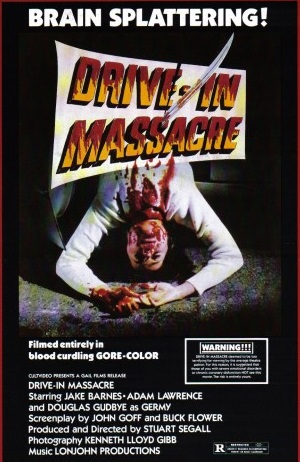
The Drive-In Massacre movie poster is duplicated in the first ten minutes as a sword-wielding freak starts dispatching movie-goers. Gotta admit, that was pretty cool. However it’s followed by the classic film cliché: the zooming in on a newspaper headline (see image below).

Some bored Barney Miller-types are called into action bemoaning “every nut in town’s gonna be callin’ in claimin’ credit!”

The drive-in manager, “the perfect asshole,” Austin Johnson is questioned and says of his clientele, “they’re all one big zit and long hair.” He oversees staff that includes a circus geek who ruined his teeth biting off chicken-heads, an obvious redneck red herring.

Drive-in-MassacreThe world’s least helpful psychiatrist is conscripted, setting back forensic sciences decades: “don’t expect any miracles…the toughest thing about this kind of case, is that there is no overall pattern for a psychotic killer!” and “a psychotic killer is usually a man.”

There’s an attempt at cinema verité (“the killer could strike again!” in the closing credits), which was better handled in Texas Chainsaw Massacre.

** (out of 5)


Motivational Growth

MotivationalGrowth_PosterWe all need a mentor in our lives. Someone who gives us a little guidance and sets us on the right path. A Tony Robbins-like figure to snatch us up by our bootstraps and elevate us to our highest potential. Granted, most don’t have immediate access to a freakishly tall, horse-toothed guru, so why not a gigantic heap of bacterial fungus instead?

In Motivational Growth, we meet Ian Foliver, a man who could certainly use some life-coaching. A depressive agoraphobe, Ian lives in squalor and hasn’t left his apartment in nearly a year. He’s disheveled, scraggly-bearded, and looks like he hasn’t seen a bar of soap in months (actually, give him a banjo and he could easily fit right in to the latest hipster band du jour.) His days revolve around watching his television, Kent (yes, he gave his television a name) and alternately looking forward to/dreading his semi-regular bowel movement. When Kent blows a tube, Ian’s had enough. He decides to take his own life.

Unfortunately for Ian, he’s as successful at self-annihilation as he is every other aspect of his life. Upon recovering consciousness, Ian discovers The Mold, a giant-talking fungus nested in the corner of his bathroom sink. The Mold, voiced by Jeffrey Combs of Re-Animator fame, dispenses wisdom and barks orders in an Elvis-drawl. The Mold refers to itself in the first-person and demands to be called The Mold (do not drop the definite article!) This despite continuously referring to Ian as Jack for some non-defined reason.

Horror has a long-tradition of animate inanimate objects, including the killer Laundry Press in The Mangler, the murderous Tire in Rubber, and my personal fave, the carnivorous Bed in Death Bed: The Bed That Eats (just Eats, not Eats People, Patton!) But a sentient fungus is original indeed. Before long, due to The Mold’s coaching, Ian’s life is on the upswing. He cleans his apartment. He gives himself a shave and a haircut. He even invites in the endearing neighbor that he has been window-stalking every morning at precisely 10:16 a.m. Yet it’s not all rainbows and lollipops. I mean besides living with a talking mold, Ian continually suffers blackouts, spews copious amounts of green goop at inappropriate times, and may or may not have murdered the grocery-delivery girl, his landlord and possibly others.

Motivational Growth, the feature-length debut by indie-auteur Don Thacker is admittedly pretty nutzoid. Definitely not your average Saturday-night date flick. But therein lies its charm. It’s inventive, unique, and certainly not something you’d see at your average multiplex playing next to the latest tepid remake of a ’70’s thriller starring Denzel Washington. Ian is a likeable sorta fella and his relationship with The Mold is at times oddly charming. And despite the film’s low budget, the practical puppeteering used to bring The Mold to life is nicely effective. There are pacing problems and the single set (Ian’s apartment) does give the film a bit of a stagy feel. Motivational Growth is also not without some ambiguity, but I feel that given the tone of the film, the uncertainty is a credit rather than a debit.

For those with a taste for the bizarre, not bad at all.

**1/2 (out of 5)