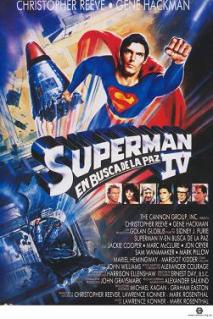
 As a child, I loved Superman. I loved the comics. I loved the cartoons. I loved the films. I still do. There is no greater embodiment of the Superhero ideal than the man from Krypton. I saw the first three Superman films in the theatre and loved them all (to a child, Richard Pryor’s buffoonery was delightful rather than distasteful.) And moviegoers flocked in droves, making the prospect of a fourth sequel a no-brainer. But in the four years between Superman III and Superman IV: The Quest for Peace, a great evil befell Superman, much greater than Lex Luthor or General Zod. Nope, it wasn’t shards of Kryptonite that felled the third Superman sequel: It was the dynamic producing duo of Menahem Golan and Yoram Globus and their Cannon Films.
At the time of production, if Cannon wasn’t quite teetering on the brink of bankruptcy, they were certainly racing toward the precipice. Hence, the film’s budget was slashed from $36 million to $17 million, resulting in the wonkiest effects in the entire series. Furthermore, the running time was cut from 134 minutes to a scant 90, making it the shortest Superman feature since 1951’s Superman and the Mole-Men and leaving Titanic-sized holes in the plot. For comparison’s sake, 1978’s Superman: The Movie had a budget of $55 million and a running time of 143 minutes. And if the tagline for the first film was “You’ll believe a man could fly”, for this one it ought to have been “Prepare to have your belief severely put to the test.”
 When the film begins, a Russian cosmonaut is working outside a space capsule when a piece of debris hits it and sends the spaceman adrift into deep space. And this is 26 years before the exact same thing set the entire plot in motion in 2013’s tepid Clooney-Bullock starrer Gravity. Luckily, Supes comes flying to the rescue and saves the spaceman. Back on earth, Lex Luthor is breaking rocks in a chain gang when his nephew Lenny, played by Jon Cryer, stages a ludicrous coup to break him out. The future star of Two and a Half Man sports a ridiculous orange faux-hawk and is resplendent in leopard-spotted jackets and tight pants. He also delivers his lines in an obnoxious, half-hearted Valley-esque manner a la Bill and Ted.
Clark and Lois (a haggard-looking Margot Kidder) are en route to the daily planet via subway, but the hapless Clark can’t get on in time. The conductor has an attack of some sort and passes out, and the train, with Lois aboard, veers out of control. But never fear, for a phone booth is near! In goes Clark and out comes Supes. He flies in to save the commuters, but everything looks wrong. The flying scenes are horribly obvious chroma key compositing, and wires are visible throughout the film. To add insult to injury, Christopher Reeve wore his flying harness underneath his red outerpants, which resulted in what looked like a giant, protruding Super-gut.
Lex hatches a plot to clone his nemesis and sets about acquiring some super DNA. Thankfully, the Metropolis Museum has a strand of Superman’s hair holding up a 1000 pound weight. Lex marches up to the display, smashes the glass and snips the follicle. I know this is a comic book film, but this scene is wrong on so many levels. First, why would a strand of Superhair be in a museum absolutely unguarded? I mean, it’s not like there are super-villains about who might think to use it for nefarious purposes, right? Second, forget the guards: Why is it behind a single pane of glass flimsier than tissue paper? Third, this is Superman’s hair, right? Strong; invulnerable; able to hold up a thousand pounds. Yet Lex is able to aquire it with a single snip of hedge clippers. They’re not even laced with Kryptonite or anything! Finally, isn’t Lex an escaped criminal mastermind convict? Why is no one out looking for him? The man is able to walk around in broad daylight without concern of being re-apprehended. Later in the film, he even says right to Superman’s face “Ever since I escaped from prison…” and Supey just stands there. You’d think he’d immediately pick Lex up and fly his escaped ass back to sing sing.
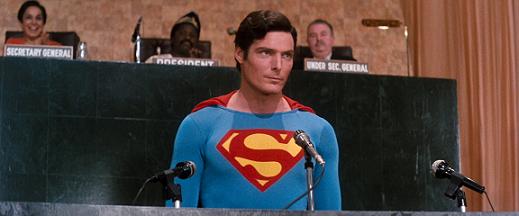
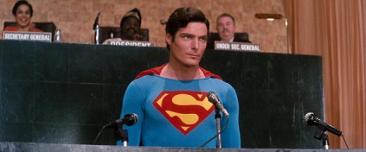 This being the 80s and all, nuclear proliferation was the concern de juor, so when the president announces that the USA needs to be second to none in the arms race, a concerned (and extremely bratty) school kid writes a letter to Superman asking him to do something about it. After some deliberation, Superman decides to enforce nuclear disarmament. He walks into the UN building (in Metropolis…although really England, as for budgetary reasons, that’s where this film was lensed) and tells a delegate of ethnic stereotypes that he is going to rid the world of nuclear weaponry.
And so the world’s nuclear superpowers (or two of them at least) launch their missiles into space where Supes is waiting to grab them and throw them into a giant cosmic garbage bag which he then hurls into the sun!
There are so many things wrong and/or wonky with Superman IV, so before this review turns into a dissertation, it’s time to start listing them bullet point style:
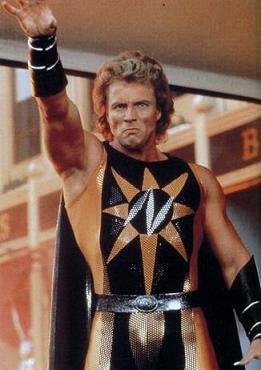
- Lex creates a Superman clone that looks nothing like Superman. Rather, his name is Nuclear Man, and he is born in the sun. He comes to life fully-formed wearing an outfit that looks like something you would see on American Gladiators, replete with an “N” insignia on the chest, despite the fact that the clone hasn’t even been named yet (and he’s played by a Chippendale’s dancer named Mark Pillow with nary another acting credit to his name.)
- Clark Kent reveals himself to Lois as Superman than takes her on a whirlwind flight over the best stock footage of the U.S. that the filmmakers could get their hands on. Upon landing back on Clark’s balcony, Lois has zero recollection of what transpired. I did not know that the ability to manifest short-term amnesia was part of Superman’s power set.
- Nuclear Man destroys the Great Wall of China by flying through it. Superman repairs the wall by using some sort of vision that rapidly reassembles the bricks. Is masonry vision another new power?
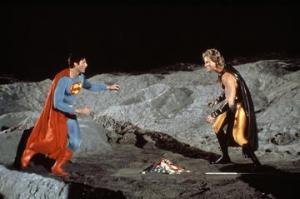
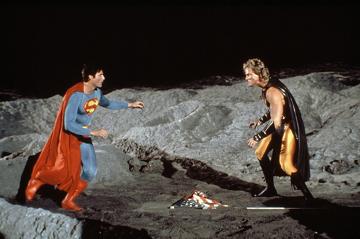
- Nuclear Man and Superman wage battle on the moon. The fight is terribly choreographed and resembles two aged WWF jobbers going at it. Steve Lombardi and Barry Horowitz would have provided more hard hitting action than what we got here.
- Superman defeats Nuclear Man by moving the moon to blot out the sun. Shouldn’t this cause tremendous global environmental destruction by altering the world’s tides?
 And I can go on. Ultimately, Superman IV was a huge flop that grossed less than a quarter of its predecessor and pretty much drove the last nail in Cannon’s coffin. And yet, for all its numerous problems, it’s nowhere near as egregious a piece of cinema as Batman & Robin. Christopher Reeve is still charming as the befuddled Clark Kent and heroic as the Man of Steel, and there is nary a Super Nipple nor Super Credit Card to be found.
Make no mistake – Superman IV: The Quest for Peace is a bad movie, but it’s not without its goofy charms. Should be seen at least once.
** (out of five)
 Dream interpretation is a lot of bunk. Still, the vagaries surrounding why we dream and what they’re all about make for interesting horror source material. Horsehead is no exception.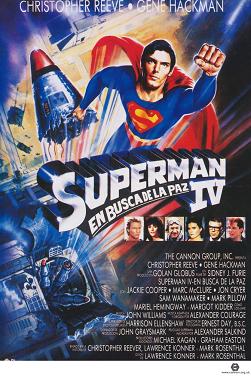
 Really Awful Movies