Wrecker

WRECKER_MOVIEIf you’re gonna out-duel Duel, you better pass inspection. It’s damn-near impossible to kick the tires of Wrecker without referencing Spielberg’s neat 1971 film about a mad menace behind the wheel.

Stephen King said this about horror on four wheels, “Even such a much-loved American institution as the motor vehicle has not not entirely escaped the troubled dreams of Hollywood.” While lots of car movies are indeed lemons, he called Duel “one of the half-dozen best” made-for-TV movies of all time. Of course, his judgement, critical or otherwise, isn’t exactly beyond reproach (During the filming of the similar Maximum Overdrive, King’s directorial debut, he was purportedly gargling Listerine and popping pills.)

But Wrecker isn’t Duel, nor is it Maximum Overdrive.

Here, somewhat generic Pacific Northwest college coeds Emily and Leslie are on a road trip through, what we can only guess is an attempt to replicate California (the signage is in km/h). It’s hard to believe the filmmakers went out of their way to recreate a quintessential American roadstop – complete with giant Stars & Stripes flag, Southern drawls and hicks – but leave in the highway metrication.

Our players: Emily is a pushover in her personal life and is the one tasked to take evasive action when a large tow truck barrels down on them. Her buddy Leslie has a foul mouth and swills beer in the front seat and has supplied the weed.

wrecker_MOVIE_still
Call the cops. Or roadside assistance. But wait, there’s no cell reception.

At the outset, there’s a neat bit of ironic chastising of the diesel-belching truck ahead of them, “Haven’t you ever heard of climate change?” (This as the girls are burning rubber and loads of fossil fuels in a muscular Ford Mustang) They try and pass the tow truck, whose driver is clearly toying with them, both on the highway and also when the duo checks in at a rest stop.

Wrecker is a bit of a mess. It has odd cinematography. We’re by no means experts, but its grindhouse aesthetic is at odds with the very present-day setting.  Not certain if this was intentional or some issue with color correction, but the film is yellower than an old man’s drawers. The filmmaker’s occasional forays into overhead digital shots is not smooth, but rather a bumpy ride indeed. Not something you’d want in a movie that’s ostensibly built for speed, although to be fair, the herky-jerky style works far better during nighttime hours.

As other reviewers have pointed out, with a speedster like theirs, they could easily have a tow-truck eating their dust (and not just a tow truck, a tow truck towing a beat-up wagon. One that was a casualty of a notorious stretch of road called “the Devil’s Pass.”) A workhouse tow truck would be no match for 300-hp, 3.7-liter V-6 of muscle car. Still, that’s a minor point.

There are fewer and fewer places these days without cell service. And this “no reception out here in the middle of nowhere” gambit is getting pretty stale. Also, some of the same hairpin turns were being used over and over again. On a no-budget production like this it’s understandable, but at least try to mask it.

Steer clear.

** (out of 5)
The Forest

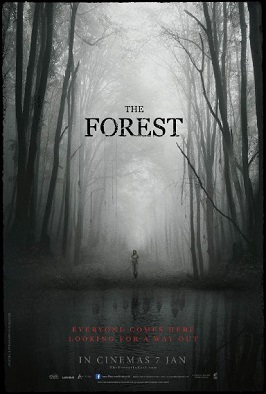
The_Forest_Poster
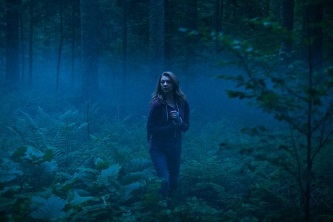
Sara (Natalie Dormer) looks around for her lost sister Jess in The Forest

Don’t Go in the Woods is one of those admonition films, (like Don’t Answer the Phone and Don’t Go in the House) but of course, folks who inhabit horror films don’t usually heed advice, even if it’s in the movie’s title.

The same can be said of these explorers in The Forest — we wouldn’t venture into these deep dark woods unless accompanied by an elite battle-hardened fighting force. And even then.

What lurks under the dense canopy of Japan’s Aokigahara Forest is great horror fodder: a real life “suicide forest,” abutting Mount Fuji (figures no longer publicized to discourage copycats). The green expanse translates into “Sea of Trees,” and according to police records, in the last available year of data (2010), there were 247 suicide attempts there. Sion Sono’s excellent Suicide Club explores that very theme, about which comic Bill Maher darkly quipped, it’s a case of, “you can’t fire me, I quit.” All kidding aside, Japan’s suicide rate is the highest in the developed world. Must be the stifling, deferential culture. After all, it was Japan that gave us this proverb: The nail that sticks out gets hammered down.

In The Forest, Sara (Game of Throne’s Natalie Dormer) is looking for her twin Jess, a free spirit English teacher who’s gone missing in those very woods. En route to find her, she meets up with an American expat in a bar, Aiden (Taylor Kinney) a fluent Japanese speaker and freelance writer, who gains her trust and puts her front and center in his next feature. Aiden then procures a handler to help them navigate the dense forest. The guide warns that they not venture forth, but venture they do…Don’t Go in the Woods, right?

FOREST_PosterThere’s another caveat: things in the bush are not what they seem, a plot convenience allowing for wave upon wave of imagined jump scares in this tree sea. Some are real (they come upon a man who’s hanged himself — an unfortunately common real-life practice there) and some are not (the cliched chimerical school girl).

Bad movies announce themselves within minutes. The problem with The Forest is that it’s beautifully shot and wonderfully paced, setting the table for a horror feast, but the entrees are underwhelming.

It’s a classic “would’a could’a should’a” flick: If they would’ve made a few alterations, it could’ve been and should’ve been great.

The notion of a real-life suicide forest is bone-chilling, but the premise is wasted. When working within the confines of PG-13, ghostly figures abound but there’s seldom a body count. And there’s only so much an audience can invest in the protagonists when there isn’t an immediate physical threat beyond what’s only seen in the mind’s eye.

The ForestThis reviewer speculated, “What if Sara was luring the guy to his forest death, WITH her twin sister as an accomplice?” There are any number of permutations that might’ve worked better, but again, this is mass market, supernatural fare. A strong dose of gritty realism as payoff would’ve gone a long way.

Leisurely unfolding like a travelogue before hitting its stride (not since Lost in Translation has Japan looked this bleak), the film has some good performances, effective jump scares and a couple of laughs as well. However, there are those nagging questions: the “Why doesn’t the search party use dogs?”; “Why spend the night in the woods when you aren’t dressed for it?”; “Why skulk about when visibility is limited?” sort of stuff.

We can’t definitively admonish viewers to Don’t Go See The Forest but unfortunately the tree is merely a sapling when it could have been a giant sequoia.

*** (out of 5) (subtract a star if not partial to supernatural horror)

[Editor’s note: The Forest has been scrutinized in some circles over alleged “cultural appropriation” — a concept as slippery as unagi — and for featuring a white Westerner having the temerity to visit another country where a sibling’s gone missing. What’s really missing though, is logic. A death forest is what’s needed for much of the hare-brained notions that pass for critical theory these days.]