 Some Freaks is not the typical type of picture you would expect to find playing at a world-renowned genre festival, but then again, Fantasia isn’t your typical genre fest. Hence, the darkly empathetic, teen-coming-of-age drama fits in perfectly alongside films by Takashi Miike and Mike Flanagan. Some Freaks is John Hughes meets Todd Solondz (or more accurately, Neil LaBute, who served as executive producer on the film.)
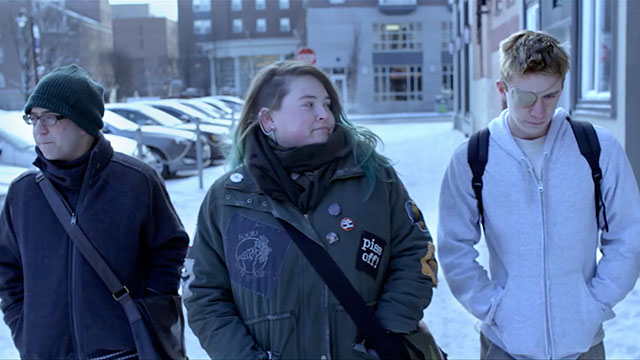
Self-identity, self-perception and self-confidence are the themes that govern Some Freaks; the word “Freak” in the title applying to just about every central character in some way or another. High-school senior Matt is definitely a freak. Literally. Missing one eye and forced to wear an eye patch, Matt (played by Thomas Mann, who was excellent in last year’s superb Me and Earl and the Dying Girl) roams the halls of his high school as his schoolmates ridicule his “deformity” with taunts of “cyclops”. Like all high school outcasts, Matt has that one friend who’s just as socially awkward as he is. In this case, it’s Elmo (Ely Henry), a stubby teen whose outward humor masks some serious insecurities as a result of his inward struggle with his sexuality. He’s a freak too, but his freakishness is more of the introspective, “I don’t know where I belong” type. Straddling the line between the internal and external freak is Jill (Lily Mae Harrington), Elmo’s cousin, who has recently transferred to their high school. In a world of “normals,” Jill is decidedly not-so. She’s overweight, dies her hair green and has multiple piercings. Her external freakishness is denoted by the cruel put-downs directed toward her, but she seems to have made peace with her freakishness. Seems being the operative word.
Of course, after an inauspicious first meeting, Matt and Jill begin to hang out. First as friends, then as lovers. Two outcasts coming together, discovering a kindred spirit and reveling in their perceived otherness. Perceived being the other operative word.
For Some Freaks is really about perception. How we perceive (and preconceive) others, sure, but more importantly, how others perceive us. And how our perceptions of the way other’s perceive us dictate the way we feel about ourselves. In No Exit, Jean-Paul Sartre famously wrote “Hell is other people”. According to the French philosopher, we become objects in the gaze of others, resulting in the feeling of shame. The gaze of the other freezes us into a sort of being that we may or may not be, but it is the other who defines us. And how we create and recreate ourselves is dependent on the approval (or disapproval) of the other.
For as long as Matt and Jill approve of one another, all is hunky dory. But when Jill goes away to college, loses 50 pounds and dies her hair blonde, Matt no longer approves. Not anymore is Jill the other whom he wants/needs her to be, and his insecurities and sense of self, once buoyed by her presence, begin to crumble. He lashes out violently both physically and emotionally, and Jill returns the sentiment.
The film raises a lot of questions surrounding identity and normalcy. It sets itself among adolescents, a time of life when the grasp on those concepts is at its most tenuous. But Some Freaks is not a film just for adolescents. First-time writer and director Ian MacAllister McDonald has created a challenging picture which will resonate with viewers of all ages – from the very young to the very old. For at the end of the day, young, old or in-between, aren’t we’re all just freaks withering within the gaze of the other? In Some Freaks, every viewer will recognize a part of themselves. And though that recognition might be uncomfortable, it is also what makes us the most human.
A must see.
**** (out of five)
 Really Awful Movies