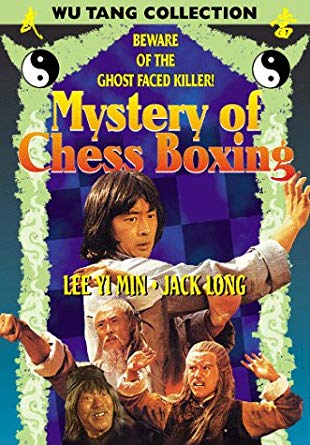
 Forget Scream’s Ghost Face Killer. This is the movie that actually originated Ghostie, one of the all-time legendary kung fu antagonists (Mystery of Chessboxing also inspired Wu rapper’s Ghost Face Killah moniker).
The plot couldn’t be any simpler: revenge. That’s the lighter fluid that fuels a thousand of these films.
Old, ruthless Ghost Face has killed Ah Pao’s father. And Ah Pao needs to go find the geezer with the monster eyebrows and the long wig that’s always threatening to come off his noggin. Problem is, Ah Pao doesn’t know kung fu and Ghost Face isn’t ready to be put out to retirement home pasture, as he’s kicked the ass of everyone else in this film. What to do? Find a kung fu school, of course!
Why? To pad running time with lengthy exercises, montages, and bits of feel the Qi jibber-jabber and everyone should be glad they did. At the first school, teachers and pupils alike torment poor AP, who is as low in the pecking order as you get without a janitor outfit and a mop. He has to bring them all bowls of rice, eventually, become such a proficient server that he’s the flare bartender of doling out rice, flipping plates over his head and behind his back and displaying such incredible dexterity that he’s…a star pupil shown everything the sensei knows?
Hardly.
Ah Pao is booted from the school, and ends up under the tutelage of a chess master, hence the film’s title. It’s there that he finally gets instruction necessary to beat the holy living tar out of the Ghost Faced Killer.
Their ultimate showdown is one for the ages, a throw-down of epic proportions.
Genre fans will get a kick out of (no pun intended) Siu Tin Yuen as a humble cook. He’s best known, of course, for his turns in Drunken Master and Story of Drunken Master.
[check out a full discussion of Mystery of Chessboxing on the Really Awful Movies Podcast]
 Really Awful Movies