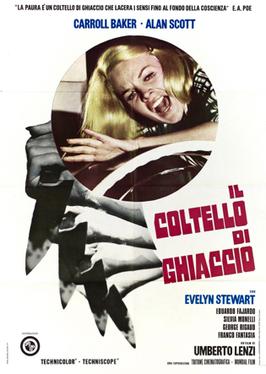
Having a character be mute is a clever, albeit annoying way to propel a narrative. In the horror genre, it’s a conceit that’s typically a response to trauma, as in Halloween 5: The Revenge of Michael Myers, or in Umberto Lenzi’s giallo Knife in Ice, whose lead witnessed her parents’ death in a train crash and has since taken an involuntary vow of silence (the exception to the trauma side-effect genesis of muteness as a character trait, is Mike Flanagan’s Hush, in which bacterial meningitis is the cause). On the gothic / Italian side of things, regardless, you just know it’s only a matter of time before a mute character eventually lets out a bloodcurdling scream.
And what better way to lay the foundation for a horror film, than with a quote from Poe, a frequent contributor to one of those “bloodcurdling” gothic horror compilations?
Against a backdrop of a real-life and very gory (no pun intended) bullfight, we get the following: “Fear is a knife of ice wich [sic] penetrates the senses down to the depth of conscience,” a sinister metaphor whose origins, like an 80s masked wrestler, are unknown. Maybe it was lost in translation. Anyway, it’s another entry in a very lengthy laundry list of pop culture Edgar Allan Poe references, from The Dead Zone, The Lost Boys to The Simpsons, not to mention the countless filmic adaptations.
Martha is our mute protagonist living in the Spanish hillside with her aged uncle, who gets a visit from her cousin, Jenny, a professional singer. And the visit, it turns out, is a short one, as Jenny’s belted out her last note, murdered by a mysterious, black-gloved assailant as is customary for a giallo.
A young girl and family friend, comes by for a visit, showing Martha her new kitten, whose fur has splotches of blood. The trail literally leads to Jenny’s body.
Soon, the young girl is no longer with us, nor is Annie, a local woman last seen bicycling around a pine forest, complete with demon symbols etched into the bark of a tree.
What we’ve got is quite a mystery on our hands, especially as the body count ratchets up, with the police looking for a “sex maniac,” with the prime suspect being a forgetful obstetrician and a hulking chauffeur, among others.
Martha in several instances, peers into the murderer’s grey-flecked peepers, including during the funeral service. And Umberto Lenzi distributes other clues deftly enough so that only the most astute of viewers can guess the outcome.
*** (out of 5)
 Really Awful Movies