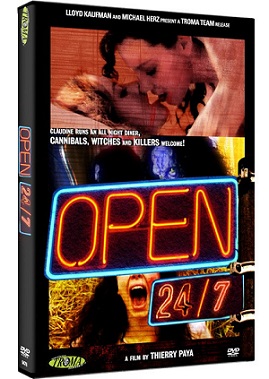
OPEN 24/7

open24-7If a girl being cracked in the noggin with a boomerang, stuffed into a sack and hoisted over her aunt’s shoulder doesn’t even crack the Top 5 strangest moments in a film, you know you’re in for something that approaches the inexplicable. And that’s OPEN 24/7, a Troma offering from 2010 (also known as Ouvert 24/7). Yes, the film’s set in France and to underscore the oddness of the film, the above isn’t even the weirdest thing to happen IN THAT SCENE. In fact, a nonchalant singer-songwriter hobo from Nashville (!) watches the cannibal aunt snack on a victim before the boomerang sails over her, hitting the niece.

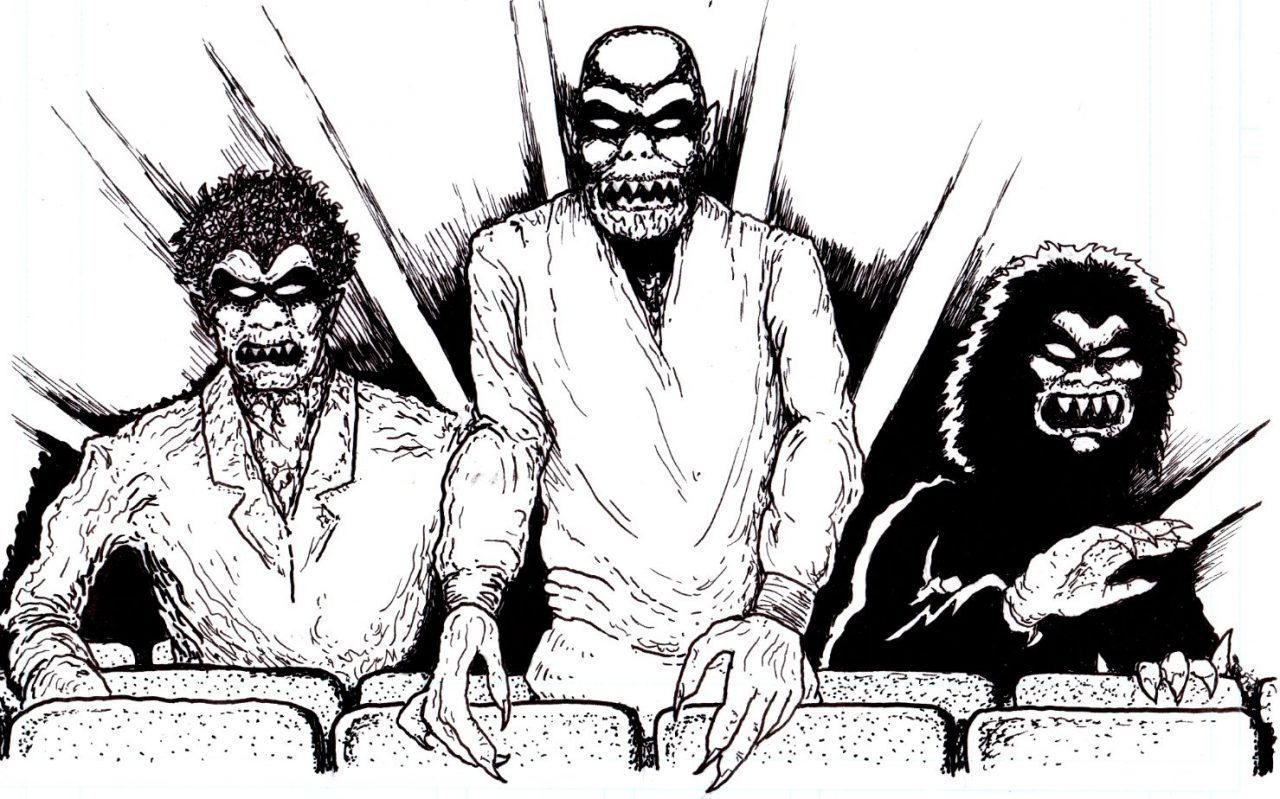
In Open 24/7, bored denizens of a French truck stop (much like an American one except stocked with way more booze) amuse themselves by telling each other stories about cannibalism, vampires and gruesome twists on Grimms’ Fairy Tales while chugging back beers (and one would hope, not returning to their rigs).

In the first vignette, a lesbian couple lures unsuspecting men over to their home, pummels them with various household objects and turns them into entrées. It’s a bit like the amazing Eating Raoul, except gut-wrenchingly disgusting. There’s something done at a urinal that you’ll just have to see for yourself. Let’s just say that a jump cut to frying sausages was apropos and that you’d understand why the investigating detective was so personally invested in the case.

In another scene, a wicked witch keeps a backyard crocodile (so obviously and hilariously stock footage) while a trigger-happy vampire-fearing (?) dimwit cop investigates.

The film veers between atmospheric/harrowing and extremely low-budget, poorly-framed mise-en-scènes that look like a Brazilian soap opera.

Still, there’s much to recommend it: Sapphic love, cannibalism, dark, dark humor. If you’re down with Troma, it’s up your alley.

*** (out of 5)
Eraserhead

News broke today that David Lynch is reviving his short-lived yet much-loved TV series Twin Peaks for a new season beginning in 2016. I was never much of a Twin Peaks fan and I’ve always had a bit of an ambivalent attitude towards Lynch. I cannot dispute his genius, and I appreciate a lot of his work, but many of his films have left me cold. Some are out and out masterpieces such as Blue Velvet and The Elephant Man, while others, such as Lost Highway, I feel are weird for the sake of being weird, inscrutable for the sake of being inscrutable.

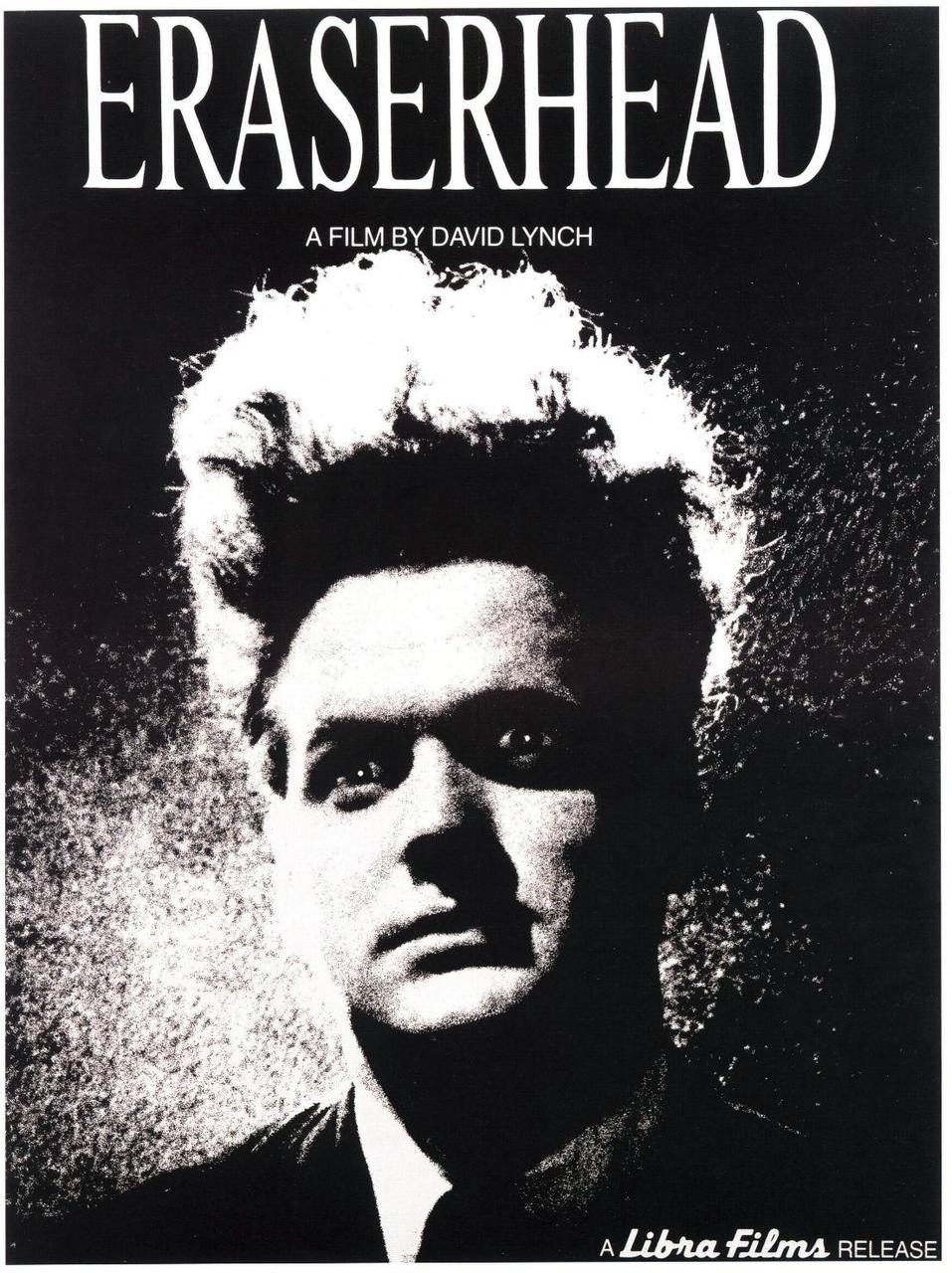
Lynch’s career has followed an interesting trajectory: ranging from the strange (Mulholland Dr.) to Eraserhead_posterthe near-mainstream (the poignant and underrated The Straight Story.) Most recently, Lynch provided the voice of Gus the Bartender on The Cleveland Show. But it all began in 1977 with Eraserhead, a film that almost singularly defines the term “cult.”

Perhaps I’m undermining my credibility a bit to say that I saw Eraserhead for the very first time last month when Criterion re-released the film on Blu-Ray. Perhaps the reason is that, for many years, the film was very difficult to find. Or perhaps I just didn’t want to see it. Nonetheless, Eraserhead’s reputation always loomed large in my conscious, and when I finally sat down and watched it last month, my mind was blasted.

Eraserhead’s influence is undeniable and yet there exists no other film like Eraserhead. Describing the plot of Eraserhead is nigh impossible as the film exists in a world with little connective tissue. Lynch describes the film as “a dream of dark and disturbing things,” and he’s spot-on. The film is as close an approximation to a celluloid nightmare as I’ll ever see. A bizarre fever-dream of weird sounds, textures, images, and rhythms. Eraserhead just is.

The film’s black and white cinematography is astounding. Each frame is meticulous in both design and composition. And the sound. My lord, the sound! Despite not a word of dialogue spoken for the first ten and a half minutes, the film is never quiet. The soundtrack is practically a character in itself. From the windy, to the industrial, to the “squishy”, to the omnipresent humming and clanging of distant machinery, the film’s sound design alone can inspire many a sleepless night. And the ceaseless, anguished bleating of the baby. My lord, the baby! Once you hear it – the high-pitched mewling of an anguished infant, it will be indelibly stamped on your brain for life.

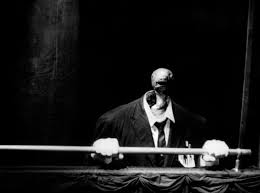
images (7)Not one character or situation in Eraserhead could be described as normal. The film is equal parts industrial and organic, alienating yet engrossing. Lynch creates a world so unlike our own that we have nothing to grasp onto for safety or reassurance. We either consciously shut it out and reject it entirely or choose to go along for the ride.

I realize I have mentioned little about the characters and events in the film and that is quite intentional. Lynch himself refuses to say anything about Eraserhead because he wants viewers to think for themselves as to the meaning of the picture.

Anyone who considers him or her self an aficionado of the weird, the bizarre, the esoteric must see Eraserhead. Furthermore, anyone who wishes to explore the endless possibilities and limitless boundaries of film as an art form must see Eraserhead. I’m just ashamed it took me this long.

***** (out of five)