 In Silent Night, Bloody Night, a man inherits a home that used to be an insane asylum. The 1948 Olivia de Havilland film Snake Pit (name-checked in Session 9, whether intentionally or not) tells the tale of a woman who finds herself in an insane asylum and cannot remember how she got there. In the Rob Zombie take on John Carpenter’s Halloween, “The Shape” is confined to a state mental hospital — but not for long as it turns out. Good help is so hard to find.
These are four very disparate films, spanning 70 years of cinema history, which exploit the fears associated with mental illness and institutionalization in very different ways.
The killer who’s escaped from an insane asylum has become a cliche in the slasher world, and his presence is usually announced via some radio dispatch.
 However, it’s what’s inside the mental hospital that presents an interesting opportunity to depict an institutionalized horror, the very real frights associated with what in hindsight seem like barbaric practices when it came to treating people with mental illness.
This includes the infamous lobotomies and psychosurgeries popularized in the 1930s, referenced here in flashback, as Session 9 focuses on a five-member Massachusetts asbestos hazmat remediation team hired through a low-ball bid to clean up a shuttered asylum.
They’re a disparate crew that comprises Gordon, a lifer who’s involved in a serious domestic abuse situation on the home front; Mike, a Tufts law dropout; Hank, a lazy, combative schemer; Jeff, Gordon’s hired help and young nephew, and finally, Phil, a boozing malcontent.
 It’s a pretty nifty conceit that director Brad Anderson (The Machinist) uses here, adding an extra dimension of fear as in addition to the horrors of the facility, the men in the “fiber business” face the real danger of asbestosis and pleura from exposure. It’s this very immediate health risk that made the non-supernatural bits of Chernobyl Diaries so terrifying. Whenever a mask is taken off or dust is kicked up, the danger is palpable.
Hank, the reluctant jobber, finds a stash of old coins , worth a fortune, and jewelry buried in a wall in the basement. He comes back to raid the place at night, and that is when he also comes upon one of the most terrifying objects in the annals of medicine, the orbitoclast, a surgical instrument used in lobotomies.
With word that Hank’s jumped ship for Miami with his new find, the rest of the crew try and make do, working around the clock to earn their big cash bonuses. But it’s when young Jeff happens upon a stupefied Hank in an asylum stairwell that Session 9 kicks into high gear.

The film stands apart as one of the most ruthless and jarring representations of bedlam ever committed to film, shot in Massachusetts at The Danvers State Hospital, also known as the State Lunatic Hospital at Danvers*.
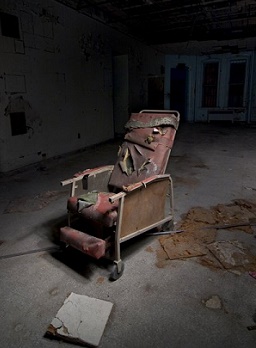
The facility is referenced in Lovecraft’s The Thing on the Doorstep, the Shadow Over Innsmouth and is a character unto itself; its decaying interior is a window into the horrors that took place, even if the structure was designed for maximum light and air exposure, part of the ill-fated “building-as-cure” movement that died to cost/maintenance issues.
Session 9’s verisimilitude is unmatched. The location shot is one that no creative designer could reproduce.
When the ghosts of Danvers are present, it adds a level of heartbreak and realism to the film. Metaphorical ghosts, that is. The residents of Danvers are very present, in tales the grounds’ security guard tells about deinstitutionalized patients returning to the grounds as they had nowhere to go and stories of repressed memory syndromes and sexual abuse. The most affecting moments come from a long-time resident with multiple personality disorder, Mary Hobbes’s voice, heard via a psychiatrist’s old reel-to-reel. Failed lawyer Mike becomes obsessed with interview footage chronicling her treatment, the course of which includes…Session 9.
It’s to the director’s credit…This is the kind of charged atmosphere that wouldn’t be present if ghosts were CG-depicted or if there was a psycho killer lurking about.
Still, a needlessly gimmicky denouement and over-length keep it a smidge away from classic territory.
***1/2 (out of 5)
[*Shamefully, the sprawling building was mostly torn down in 2006, despite attempts by the town Historical Commission to file an application to have it registered in the US’ National Registry of Historic Places]


 Really Awful Movies