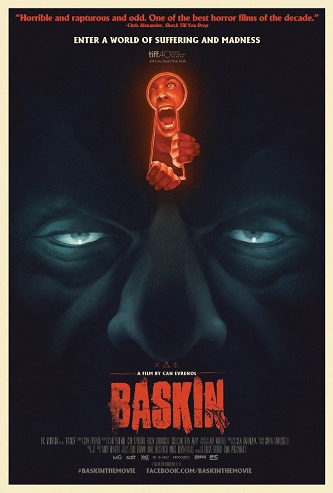
 Simply sumptuous, Baskin inhabits a rich hue of orange blue color spectrum decadence one might associate with Bava’s Planet of the Vampires. And without about as much sunlight. It makes Only Lovers Left Alive look like Blue Crush.
We meet a group of boisterous lawmen in a bar. They’re telling bawdy brothel tales when one of them does a Turkish variant of Joe Pesci’s “What do you mean funny, funny how? How am I funny?” spiel from Goodfellas, before beating down the proprietor’s son.
The squad, after one of them suffers a claustrophobia panic attack in the tavern restroom, shamble out into the parking lot and figure out who’s most capable when it comes to driving the van back to the station…
After a spirited radio singalong about the wonders of Chechen girls, the cops roll into a ditch…only to emerge…outside a decrepit relic of a mansion, once home to a police station during Ottoman rule.
They pull out their flashlights, call for backup which never comes, and press ahead after getting a “pig” dressing down from a figure lurking in the shadows.
It’s inside the bowels of structure that the group encounters a candle-lit chamber of horrors.
 Baskin is a near perfect synthesis of supernatural and torture — with way more visual style than the latter usually offers and dollops more gore than the former. If only either genre was done with this much elan…
The attention to detail in Baskin is simply astounding. Case in point: the puddle one of the cops steps in en route to the abandoned police station and the quiet, drawn out ablution one of the building’s scary inhabitants performs before unleashing a trenchant speech about power-worship and the nature of evil. The twist is wonderfully executed too.
Gorkem Kasal is compelling as the fresh-faced recruit Arda, whose nightmarish childhood visions foretold the torment that would later come to pass. Muharrem Bayrak is solid as the grizzled tough-talking Yavuz. (For a movie with a cast of boorish, power-abusing thug cops, it’s amazing how their humanity shines through, especially in the face of the inhuman.) However it’s Sevket Suha Tezel as the mute balletic manservant “Master Creep” who steals the show, as close we might come in the modern era to an iconic new villain.
Istanbul’s Can Evrenol knows when to dial it back when required, and when to go full Fulci on a plot fulcrum. The director opens a portal into hell that’d make il maestro proud.
**** (out of 5)
 Really Awful Movies