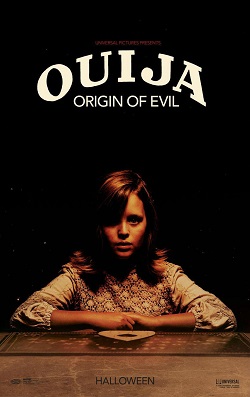
Ouija: Origin of Evil

ouija_two_Ouija: Origin of Evil is a film torn between two poles, like the evil board’s pointer between YES and NO.

Some parts of the film are so conventional, it should be screened in a hotel conference room.

However, a few curveballs are lobbed in to make this prequel more interesting than it has any right to be.

The brainchild of director Mike Flanagan (Oculus), who presumably knows a thing or two about witchcraft (he’s from Salem, after all), Ouija: Origin of Evil adds a twist to the supernatural genre: the family at the center of it are scammers, much like palm readers/psychics and other such mountebanks are in real life.

That’s a pretty neat conceit, as we’re introduced to the Zander family in 1960s Los Angeles, manipulating both the board from under the table and a client, answering questions about a loved one from beyond. Having a family of effortlessly charming chiselers definitely adds an extra dimension of interest to Ouija. (FYI, when it comes to the supernatural, the authors of this site’s caveats need caveats. We can’t stand the genre.)

The family seance showbiz team consists of mother Alice and daughters Lina and seemingly innocent nine-year old young one Doris (Lulu Wilson, below, a future star in the making who runs away with this film). Doris even asks at the outset, when a grateful client leaves after a session, piece of mind intact, “What’s a scam?”
ouija_origin-of-evil_2016However, when the very real powers of little kid are revealed to mother and elder daughter through mysterious Polish language missives scrawled in impeccable cursive in her room, Catholic school principal Father Tom is forced to intervene and then things go haywire.

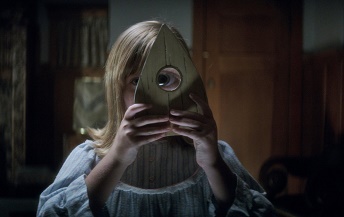
That’s where we get some of the film’s most memorable scenes: Doris explaining the finer points of strangulation to Lina’s nonplussed beau Mikey, and the undeniably creepy little kid viewing the other realm through the pointer’s lens (as in the image above).

Kudos to Mike Flanagan for his directorial flourishes, sure, but also for the toe-tags. Yes, this supernatural flick actually has a body count! It’s a common grouse of this reviewer, that with hardly any fatalities in this often tame sub-genre, it’s hard to get emotionally invested.

True, there is some genuine silliness as widower Father Tom, all hot under the collar, goes to a fancy restaurant with Alice, who’s sporting a low-cut blouse, and the calls for an immediate exorcism are somewhat laughable…

Still, with low expectations comes a few rewards…Who would’ve thought?

*** (out of 5)

The Canadian Horror Film: Terror of the Soul

the_canadian_horror_film“One must put up barriers
To keep oneself intact…”
Limelight, by Rush

Canadian identity is more about negation than affirmation – what we are not – paradoxically, “not American” despite being culturally similar enough that the differences between the two great nations are pretty superficial: the absence of proper Chinese takeout containers north of the border, the presence of bagged milk (which terrifies Americans) and favoring “nir-von-a” over “nir-van-ah.” (And for that matter, favouring “favouring” over favoring…with those ubiquitous “ou”s of the King’s English.)

American identity has become our identity, at least if you consider our obsession with it (not reciprocated) and the fact there’s no discussing Canadian identity without relating it somehow to our neighbors. Hard to imagine Italian identity, for example, wrapped up in the question of what Switzerland thinks.

Constricted by the leg irons of defining a national identity in a place defined by what it isn’t, is it even possible to make universal claims about identity through art, and especially art as maligned as the horror film?

The authors of The Canadian Horror Film: Terror of the Soul attempt to do just that, a daunting task that they’re mostly more than up to.

We hail from a land of cultural protectionism – almost a necessity given a wide swathe of underpopulated geography, mostly huddled within ear and eyeshot of American popular media, snowed under by its popular culture.

Black Christmas
The infamous bag asphyxiation of Clare (Lynne Griffin) in Black Christmas

The National Post even held a debate about whether Rush would’ve succeeded without government regulation of domestic culture.

And of course, feature films deemed certifiably “Canadian” were preferentially selected-for with tax credits, and this launched our domestic horror film culture: the infamous Tax-Shelter Era that spawned faves like Black Christmas (shot near Toronto’s Casa Loma), Prom Night (filmed at a high school in Toronto’s east end) and, My Bloody Valentine (lensed in Sydney Mines, Nova Scotia).

There’s been much ink-letting when it comes to those, so it’s great that a book such as The Canadian Horror Film goes for the deep cuts, looking at a broad ribbon of horror subject matter including eco-horror, the Canadian landscape, the tax shelter era and of course, the inescapable presence of Cronenberg – some of which is admittedly mystifying to anyone not holding a Canadian passport, but luckily, enough to chew on for goreheads regardless of nationality.

The Canadian Horror Film includes a discussion about the quietly intimate relationship between a radio host and his listeners in Viral Culture: Canadian Cultural Protectionism and Pontypool. It’s a film with a denouement that left non-Canadians cold, but took on a special resonance with us. This piece, by Rue Morgue contributor Andrea Subissati (aka Lady Hellbat), looks at the occasionally tense relationship between the US and Canada, and “our desperate attempts to articulate our distinction” in the face of “cultural cringe,” the phenomenon that occurs when our domestic art doesn’t seem to measure up to the stuff we’re bombarded with from Hollywood (which ironically, is inundated with Canadian cultural influence, fed back to us in a weird hall of mirrors).

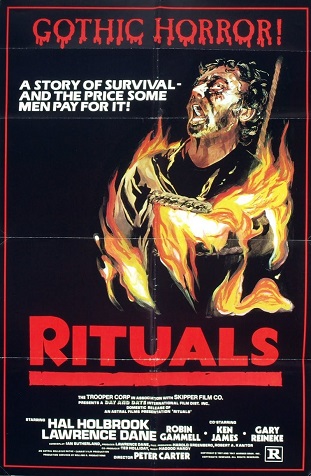
RITUALSThere’s a neat, heady discussion of the seemingly intellectually torpid Jaws knock-off, Orca. Professor Peter Thompson of Carleton University invokes the garrison mentality in his discussion, a hunkering down, collectivist impulse in the face of difficult circumstances and an unforgiving wilderness, which differs markedly from the rugged individualism stateside and a desire for conquest and expansionism – the “go West young man” credited to Horace Greeley. The essay touches on East Coast politics as well as boundary transgressions (shared with Jaws) and the dramatically more interesting creature the movie focuses on, one that is more easily humanized, a la Shamu, for which there’s no analogue in the shark world.

There is also an illuminating take on what is, in this reviewer’s opinion, essential Canuck horror viewing – Rituals, often derided as a low-rent version of Deliverance but which has a great deal to offer. Filmmaker Mark R Hasan explores the world of bickering doctors deep in the Ontario bush on a fishing trip who are hunted down one-by-one by a mysterious figure. The film’s put in the context of the then predominant cinema scene, which disproportionally consisted of National Film Board documentaries touting the incomparable beauty of the Canadian wilderness. It was a strong and welcome backlash against this.

While The Canadian Horror Film is an offering from University of Toronto Press, don’t expect a dusty belfry in this ivory tower. This is smart, yet accessible stuff.

Christopher Lombardo is co-author of Death by Umbrella! The 100 Weirdest Horror Movie Weapons and co-founder of the Really Awful Movies Podcast.