
Phantasm: Ravager

phantasm_ravagerPhantasm: Ravager is light years removed from any of its predecessors. It was meant to be a love letter to the series, but in reality it’s like getting dumped by text.

Some have called it “cut and paste,” others, “episodic.” But really, that’s a kind way of saying “incoherent” by people too immobilized by their love for the characters that they’re willing to overlook what is a cheapjack bit of dung.

We get sent cut-rate productions by budding filmmakers all the time. And we’ve routinely seen $50,000-dollar budgets better spent.

It’s amazing to think this is the very same series that produced Phantasm II‘s awesome “hunchback apparition,” a few of the whiz-bang practical effects created by Greg Nicotero (in a movie series not especially known for its effects).

As far as sequels go, that’s as far as this reviewer ventured into the mystical land of the Tall Man, and there was exactly 10X the budget available for that one — lauded in the Chicago Tribune for its ability to “sustain the dream-like sense through…very sophisticated manipulation of space.”

The same could be said of A Nightmare on Elm Street, whose installments The First and Third are clinics in how the dream world should be depicted on film.

But that space needn’t require large $$$s to fill it. After all, the first Phantasm film only set producers back $300,000 and it looks amazing, even more so by comparison to this.

And that’s the key right there. Film.

For as good as the 4K restoration of the original Phantasm is, Phantasm: Ravager is precisely as bad.

In lucid dreaming, the dreamer is aware that they’re in a subconscious state. In Phantasm: Ravager, it’s impossible not to be aware you’re in straight-to-digital hell, a different kind of hell, where the only thing that’ll be possessed is several hours of your time.

The film’s opener shows promise and is pretty terrific: a bedraggled Reggie emerges from the bushes on a desolate stretch of Texas highway. He car-jacks back his Barracuda ride, which is being driven through the desert wasteland by a nebbish who appropriated it.
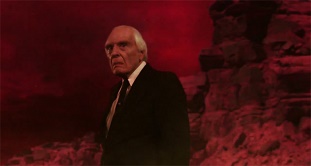
tall_man_phantasmIt’s out in the barrens that the silver baubles bear down on him, and Reggie’s glove compartment is still home to his piece, which he uses to shoot the balls out of thin air.

It’s this kind of surrealism and Reggie’s later chance meeting with the ethereal redhead Dawn that reviewers of the first and second film likened to the surrealist works of Luis Buñuel.

But it’s after he drives Dawn back to her ranch that things go astray. Reg pathetically tries to woo her with a guitar composition, despite being two decades her senior. It’s a piteous metaphor for the film, a sad attempt at recapturing past glory.

When the Tall Man eventually makes his presence felt, it’s jarring (as we’ve come to expect for the series) and the backdrop of an aged Reggie ravaged by dementia, gives the film a sense of intrigue via potential unreliable narrator.

However, it’s when the gigantic spheres begin hovering in the heavens that the effects get pretty terrible, and when Reggie enters another spatio-temporal dimension,  the overarching silliness kicks into high gear. Too bad really, as it’s undeniably thrilling seeing the band back together. However, nostalgia and goodwill only carries limited currency. If the instruments and  gear are substandard and the set-list ill-considered, the concert will undoubtedly suffer.

The Tall Man deserved a better swan song.

** (out of 5)

[CHECK OUT OUR PODCAST OF PHANTASM]

Cannibal Holocaust

Cannibal-HolocaustWhat can you say about Cannibal Holocaust that hasn’t already been said?

It’s certainly among the most gruesome, savagely unrelenting and uncompromising films of all time. And they should’ve compromised, at least with respect to the animal abuse, which is absolutely inexcusable.

Since much of this non nutrient-rich jungle topsoil has already been covered, it’s worth comparing Cannibal Holocaust to another Italian jungle cannibal film about which similar criticisms were justifiably levied. And that’s Cannibal Ferox.

Think of this as a Cannibal VS Cannibal Tale of the Tape (or maybe tape worm, given their locales).

Both films are directed by Italians. Both feature indescribably repellent westerners traipsing about the Amazon like they own the place and abusing the natives. Both films start in New York City. Both feature aerial footage thereof and of the real, not urban jungle. Both ease into the nastiness with bugs, feature awful animal abuse, anthropologist protagonists, appendages being lopped off, entrails eaten…

The key difference is how the source material, however base, is handled. Ruggero Deodato’s genius involved introducing the world of horror to the found footage conceit in 1980, which here works exceedingly well. (It’s since been beaten like a dead horse…or rather, like a dead horse whose dying moments were captured for posterity on video.) Many were actually fooled into thinking this was real at the time and Deodato was famously brought up in his native Italy on obscenity charges.

Cannibal-Holocaust_movie_The mission here is much more serious than the ersatz academic one in Cannibal Ferox, with its PhD student and two “assistants,” who’d fare well in a road trip to The Big Easy but whose propensity to pack whiskey rather than foodstuffs were not the proper stuff of research expeditions. Cannibal Ferox is an inherently silly film, with leering guides and inane dialogue that compromise its most gruesome set-piece – the hanging scene.

By contrast, Deodado lures the viewer into the Amazonian jungle via a seemingly legit anthropologist; and his rescue mission is led by rough-and-tumble guides who know how to handle weaponry and in whom an audience invests.

When they find video footage of the ill-fated expedition, we visit the jungle’s heart of darkness a second time. We really do get a sense, from beyond the grave of what the videographers had to deal with (and how they were mostly to blame for their fate, surrogates for manipulative Italian media conduct if we’re to believe Deodato’s inspiration).

Umberto Lenzi, on the other hand, introduces us to an evil force in Cannibal Ferox through noted genre kingpin John Morghen as unhinged Mike. He’d already been characterized (or caricatured) as a New York City dope fiend, so when he decides to take his drug-fueled frustrations out on the jungle dwellers upon meeting up with the researchers, it comes as no surprise.

Deodato makes his protagonists sympathetic and takes you into their world first through Dr Monroe, the anthropologist leading a rescue mission, then via an initially credible (if solipsistic) team of filmmakers.

Cannibal_holocaust_filmAlso upping the interest ante, was having not one but two warring tribes in this part of Amazonia, and Western interlopers picking sides to add more fuel to the fire. This story was part of the founding of Canada and carries on to the geopolitics of the present day (and no, we’re not comparing the conduct of the Huron or the Iroquois to the tribes depicted here).

It’s certainly a more interesting idea than Gloria, the PhD candidate’s inane null hypothesis regarding conquistador-generated rumors of cannibalism that she later won’t even admit to being actually true.

The notion that the Western Left has a blind spot regarding other culture’s transgressions is the very interesting idea behind Eli Roth’s The Green Inferno. That film got its title from Cannibal Holocaust.

To sum up though. Cannibal Holocaust by a nose, so to speak.

But really, these films defy critique. It’s a bygone era and there’s no way to recapture the amoral (OK twisted), devil-may-care guerrilla ethos that went into them. Nor should anybody try.

**** (out of 5)

[Explore the jungle in our Cannibal Ferox podcast]