 Gaga: Five Foot Two wasted a prime Spinal Tap moment: when the pint-sized New Yorker drops her album, as well as her over-the-top glam in favor of shorts and a black-T. How much more black could it be? The documentary (on Netflix) gives us all-access Lady Gaga, a woman whose fashion audacity is unmatched, but whose music is about as interesting as a basic wardrobe staple.
At 31, she’s at the age that linebackers are cut from the NFL, and pop stars face oblivion (Gaga, aka Stefani Germanotta, references that decade milestone as a time when she can “start to become a woman”). Is Gaga: Five Foot Two a Hail Mary* to stay relevant?
Gaga has always painted herself into a corner, musically: despite avant-garde aspirations, she’s still the equivalent of “the office weirdo” if she worked for an actuarial firm. If she were truly weird, she’d release Metal Machine Music, instead of courting lanky tastemaker-du-jour Mark Ronson, the man behind the boards for Uptown Funk and Rehab, as her career threatens to go gently into that good night.
It’s taken long enough for her to realize she’s a Six Foot Two pop talent, who doesn’t need all the Donatella Versace trappings, meat dresses, songs about fame (always the dullest subject matter in any artist’s repertoire) and assorted nonsense. To wit: the gorgeous acoustic lament, Joanne, written for a late aunt, which has a vulnerable Nico tone lilting into a Rufus Wainwright chorus, “Girl, where do you think you’re going?”
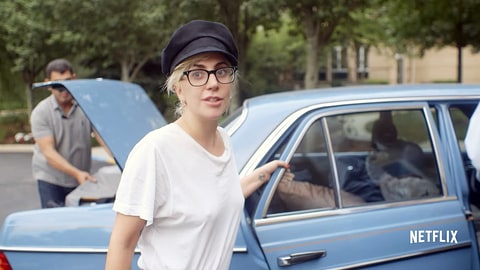 The same could be asked of Ms. Germanotta, and with Interscope money behind her, a bevy of handlers, hangers-on, stylists, physiotherapists — one wonders if the art doesn’t suffer in the process.
And she apparently suffers for her art too. In Gaga: Five Foot Two we get to see her at the doctor, getting hip injections, getting rub-downs, massages, the works, and at one point asking, “what would happen if I didn’t have all this?” [wealth].
At that point, as she gazes forlornly off her penthouse balcony over Central Park, you might want to whistle for the world’s smallest violin, but that’s the neat tension that this doc brings. Seldom do you get to see the creative process laid bare (Metallica’s Some Kind of Monster also does this), even if the “supporting cast” buzz around her like bees and are barely background furniture.
Most importantly, as far as her image goes, the indifferent will likely become casual fans…
*** (out of 5)
[Editor’s note: The opening sequence is a stunner: Gaga hoisted into the sky to perform for the Super Bowl half-time show]


 Really Awful Movies