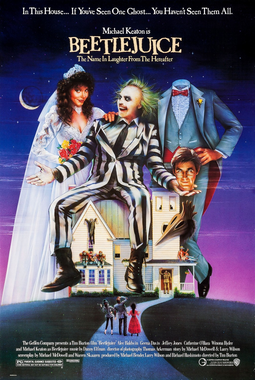
 As champions of Italian horror, we’re eminently familiar with style over substance. In Beetlejuice, this is similarly true, a sumptuous visual feast (hell, this one also features a dilapidated house, a book of incantations, and a Dario Argento color palette, so perhaps it’s a kindred spirit).
A couple (the Maitlands) drives off a bridge and drowns, only to find themselves in an underwhelming afterlife, roaming their own home as ghosts, with New York interlopers redesigning their homestead to their own particular design aesthetic.
The now late Barbara and Adam Maitland discover a Handbook of the Recently Deceased, which grants them a caseworker and an associated ID and introduces them to posthumous bureaucracy (the similarities to the Ted Danson vehicle, The Good Place, are pretty obvious as the deceased tries to make heads or tails out of their deadness).
Trying to circumvent all that red tape, the couple summons Beetlejuice, a “bio-exorcist”, so that he can scare the bejeezus out of the new tenants and the Maitlands can resume their rightful place at home (interestingly, director Tim Burton once referred to Beetlejuice as a “burlesque version of The Exorcist”).
A restless and ever-creative spirit, Burton was being pitched crap projects that included Hot to Trot, about a talking horse of all things. Perhaps it was detritus like that, which got the creative juices flowing as Beetlejuice is as imaginative a series of set pieces as you’ll ever see.
The star, of course, is Keaton as the title character, a foul-mouthed decaying rapscallion and fast-talking chiseler stuck in a hokey diorama (The bio-exorcist’s qualifications? “I attended Julliard… I’m a graduate of the Harvard business school. I travel quite extensively. I lived through the Black Plague and had a pretty good time during that.”)
His performance is so engaging, so over-the-top and so effortlessly memorable, it threatens to overwhelm the proceedings at times. Luckily, there’s the ever-dependable Catherine O’Hara and Wynona Ryder to keep things in check.
**** (out of 5)
 Really Awful Movies