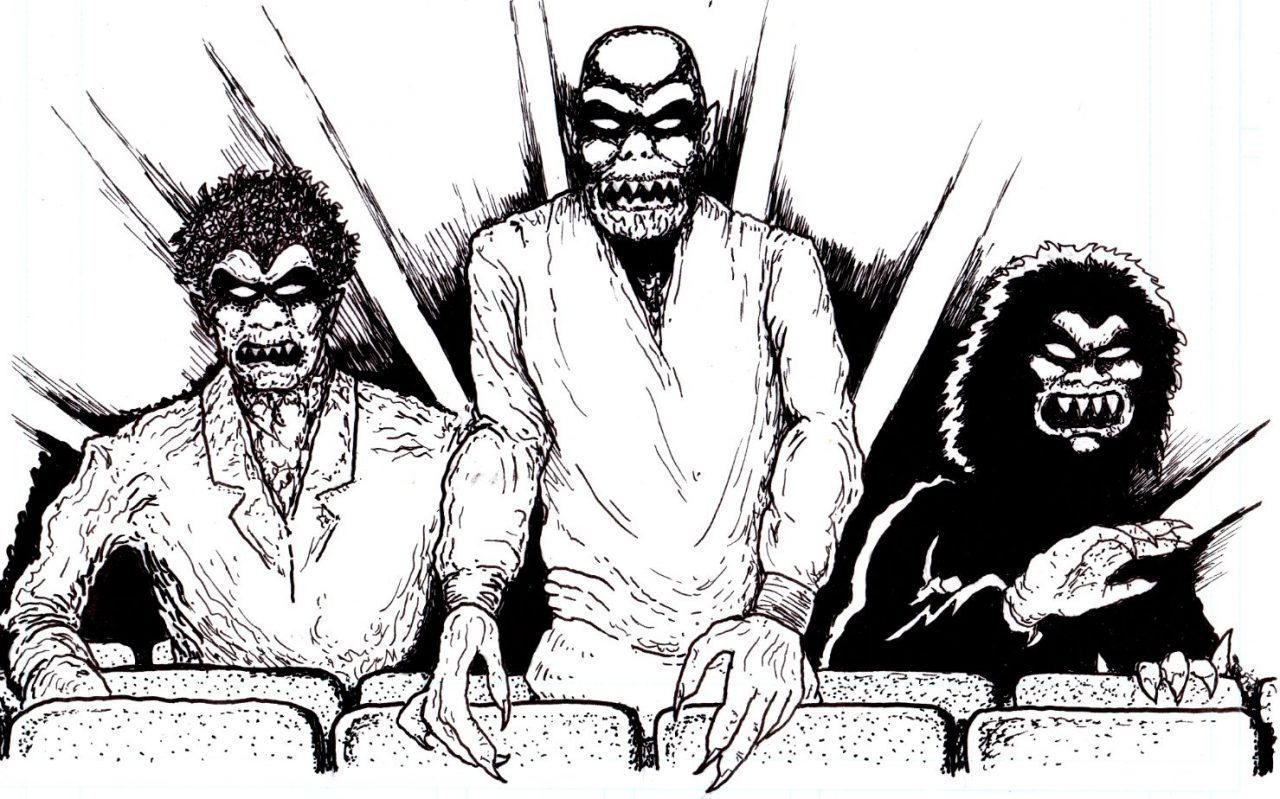
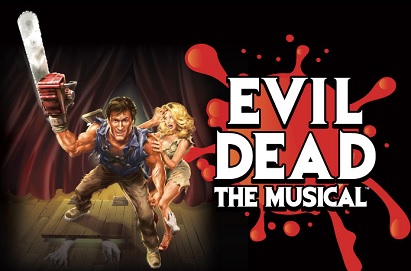
Evil Dead: The Musical is making its eagerly awaited return to Toronto February 12-28, 2016 at the Randolph Theatre and we have two tickets to give away for the February 17th performance, courtesy of Starvox Entertainment.
For the giveaway, all you have to do is listen to the end of our interview with Chris Bond, the co-creator and director of the show the Toronto Star called “bloody hilarious.” You could also win some great show merchandise as secondary prizes, so we encourage all, even those not in the Toronto area to enter. Check out the Really Awful Movies Podcast for more. The deadline for entries is February 1.
In the interview, Chris talks about the show’s humble origins “in a rickety bar”, what exactly happened when the show debuted on the auspicious night of the 2003 Northeast Blackout, getting the approval from Sam Raimi and Bruce Campbell and whether the show would’ve continued if he hadn’t. Also, what’s up with The Splatter Zone, that show-within-a-show? How did that infamous seating section come about? What accounts for the enduring appeal of Evil Dead and what’s Bruce Campbell’s involvement with the show? Also, what does Chris think about Ash Vs. Evil Dead.
We urge you to listen to the whole episode as Chris is a terrific guest. You’ll glean great insights into how Evil Dead: The Musical became a worldwide phenomenon from Vegas to Seoul to Toronto and beyond.
Good luck to everyone who enters!
And remember, The Really Awful Movies Podcast has new episodes every weekend and features horror and genre film reviews, interviews and terrific giveaways. Thanks for listening.
Which one of these three has obviously never tossed a pigskin around in his life?
The Talented Mr. Ripley spawned The Untalented Mr. Wiseau’s infamous creation The Room. Co-star Greg Sestero, in his book The Disaster Artist: My Life Inside The Room, The Greatest Bad Movie Ever Made, recounts that the oddball auteur found the Matt Damon vehicle particularly moving — particularly as he was prone to nodding off within minutes of any screening.
If you’ve ever wanted to find out what it was like behind the scenes of the notorious trainwreck, Sestoro’s book is a great place to start. To quote Mr. Wiseau in the DVD extras, “The Room teaches us what not to do.” He was referring to love, betrayal, bonding, friendship and the themes of the film but it could apply more generally to the creative process. And to his process, which was weird to say the least.
Wiseau, to nobody’s surprise, is an inveterate devotee of James Dean. Together with Sestero, they did an impromptu road trip recreating the legendary actor’s last drive and even dined at establishments favored by the late icon. Wiseau lifted “You’re tearing me apart” right from the pages of Rebel Without a Cause, and Tommy was a man with plan: to take acting classes doggone it, to make it in the film business.
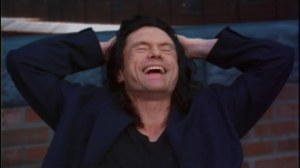
– Ha-ha!
However, there was really no fixing anyone who sounded like a Hungarian Christopher Walken and looked like a drowned rat. In Sestero’s book, we find out Wiseau likes to guzzle Red Bulls, a habit no one would ever guess from witnessing his cock-necked bovine turn as “Johnny.”
Regarding the weirdly sinewy Vlad the Impaler, Sestero admits his favorite physical description is (paraphrasing here): one of those goons in a Van Damme movie holding an Uzi who gets thrown off a catwalk.
A veteran ofthe populist Stella Adler Academy in Los Angeles as well as Shelton’s Studios in San Fran (we note that Wiseau’s name is omitted from an alumni list that includes Peter Coyote, Danny Glover and Howard Hesseman) the man didn’t take no for an answer.
His answer to the slew of “don’t call us, we’ll call you” responses to his would-be show business overtures was to fund and star in a bizarre clothing commercial showcasing Hamlet’s famous soliloquy. He had absolutely no idea the passage is a rhetorical question about ending one’s life. Regardless, the spot got him SAG accreditation. Then upon seeing The Talented Mr. Ripley, he figured he’d make his own damn movie, to borrow a phrase from our buddy Lloyd Kaufman.
– Who the hell is that guy?
Wiseau’s what-can-only-be described-as “unique” approach to diction and the English language is in full display in The Room. Because it’s a vanity piece with unchecked authority, it was his way or the highway, and when the DP walked, he basically hired a guy right off the street. And that wasn’t the only position that was a revolving turnstile.
Sestero was “line producer,” a position responsible for handling any problems that come up during production. And these were NUMEROUS. And Sestero wasn’t entirely sure what a line producer was, but he was given the job by Wiseau nonetheless. Hard to expect less from a man who described film continuity as being “in your head.”
Scenes were unnecessarily re-shot to the tune of $80,000 and green screens were used to inexplicably replace stunning, natural rooftop vistas. Costume designer Safowa Bright says Wiseau’s wardrobe selections were “unfilmable”, and Sestero himself nearly walked away from his role as Mark when the infamous set piece in which they goaded a reluctant Peter into playing catch in a tux went off the rails. During the soon to be oft-imitated CHEEP CHEEP CHEEP taunting, his embarrassed smile is captured in the final product.
In The Disaster Artist, we learn the origins of the mysterious “Chris-R” and also the more mysterious dash — and the performance, acknowledged by Sestero to be “the best one in the movie.” For those who haven’t been initiated into The Room, Chris-R is the 8 Mile thug-type who shakes down indebted Denny for drug money in as non-sequitur a scene as has ever been filmed.
The Denny character’s frankly baffling presence in The Room is a neat focus of discussion: Sestero acknowledges the obvious homoerotic undertones and the unconvincing casting of someone in their mid-20s as a teen; not to mention Wiseau’s Johnny and his lunatic, mystifying father figure role to the boy (who infamously stumbles into an intimate scene involving Johnny and Lisa, has a tickle fight and is told “three’s a crowd.”) This odd menage means this ward of the state needs another foster family, tout suite.
“People are people.” Sage advice from The Room’s resident psychologist
Everyone has their favorite Room moment. This reviewer’s is when psychotherapist Peter (Kyle Vogt) presses Johnny about “the interesting story” of how he met the love of his life Lisa, and the tale is the least interesting story imaginable, so much so that Sestero’s Mark character even asks (very truthfully) “what’s the interesting part?”
(The scene recalls The Simpson’s send-up of a boring celebrity raconteur: “I called my good friend Sting. He said, “Krusty, when do you need me?” I said, “Thursday.” He said, “I’m busy Thursday.” I said, “What about Friday?” He said, “Friday’s worse than Thursday.” Then he said, “How about Saturday?” I said, “Fine.” True story!)
A close second fave is the sudden introduction of the heretofore unseen, unmentioned “Steven,” who appears at the 76-minute mark and begins interacting with everyone and taking a deeply vested interest in the lives of Johnny, Lisa and Mark. It’s the film’s most Ed Woodian and charming moment.
The Disaster Artist is must-read material for the true behind the scenes stories involving this infamous cinematic dud. As you read, you’ll find yourself speaking in Wiseau’s marble-mouthed cadence. And you’ll be amazed that the guy behind the infamous production is not altogether different from the man who appears on screen.
With a nod to Voltaire, if this cinema god didn’t exist, it would be necessary to invent him. Ha-ha! Ha-ha!
 Evil Dead: The Musical is making its eagerly awaited return to Toronto February 12-28, 2016 at the Randolph Theatre and we have two tickets to give away for the February 17th performance, courtesy of Starvox Entertainment.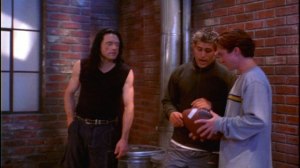

 In The Disaster Artist, we learn the origins of the mysterious “Chris-R” and also the more mysterious dash — and the performance, acknowledged by Sestero to be “the best one in the movie.” For those who haven’t been initiated into The Room, Chris-R is the 8 Mile thug-type who shakes down indebted Denny for drug money in as non-sequitur a scene as has ever been filmed.
 Really Awful Movies