Death Wish 3

DEATH_WISH_3

[CHECK OUT OUR DEATH WISH 3 PODCAST HERE]

Death Wish (the first) is an undeniable classic, derided in some circles as “fascistic” (as if wanting to avenge the murder of your wife is some impulse that exists purely in the realm of speculation).

Those people get their vigilante kicks from Batman, which is Death Wish-lite.

Politics aside, Death Wish 3 further erodes the legacy of its progenitor and proved that the series had far much farther to fall. (Who knew after the stench left from Death Wish 2?) And this thing stinks like so much garbage in an East New York Brooklyn alleyway.

Now, Paul Kersey is back in The Big Apple and apparently down on his luck too. What person of his means would take a lowly bus into New York’s Port Authority?

He goes to visit the series’ heretofore unmentioned “best friend” Charlie, only to find he’s been beaten and left for dead. Kersey is immediately hauled into the police station, despite lacking a motive. With the lousy homicide clearance rate of police forces in the Death Wish movies, perhaps cops just bring anyone even remotely related to a crime scene into custody, hoping that charges will stick?

DEATH_WISH_3_VILLAIN
Beware 80s goons with Bizarro World mohawks

He’s offered a deal by a police big-shot: work for law enforcement as a hitman-for-hire or face jail-time as “the vigilante,” an unbelievably slipshod and dunderhead premise that actually does fit the epithet “fascistic.”

He’s given carte-blanche to waste anybody even remotely related to the drug trade, and unlike the reticence to take matters into his own hands in the ambiguously dark first Death Wish, he relishes in his street justice. (It’s creepy how he describes the firepower of each weapon he’ll use to blow away the usual 80s assortment of extras from The Warriors.)

Death Wish 3 is marred by the imprimatur of Cannon. There’s a hopelessly ridiculous scene with elderly Russians allowing their place to be booby-trapped with a nail board, and a World War II vet offering use of his giant Browning machine gun (!) to blow away street toughs. Maybe the latter’s appropriate though: Death Wish 3 has a higher body count than Saving Private Ryan.

There’s also the endlessly captivating dialogue like “Chicken’s good. I like chicken,” when Kersey accepts an offer of a home-cooked meal from his public defender love interest (and her interest in him stands out as perhaps the stupidest conceit of the whole film — and that’s REALLY saying something as the film’s finale shootout is one of the stupidest things in recent memory).

Jimmy Page once again supplies the keyboard-heavy soundtrack awfulness, and this one really goes down like a lead balloon.

** (out of 5)

Day of the Dead

Day_of_the_Dead_(film)_poster

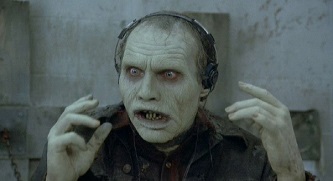
Day of the Dead may be the talkiest, goriest (thanks to the fantastic work of Tom Savini and Gregory Nicotero) and most languidly-paced of Romero’s Dead trilogy, but it’s by no means the slightest.

DOTD focuses on community building, rather than one that’s being torn down. It’s a post-apocalyptic zombie film rife with Platonic tension between guardians and auxiliaries — the former rulers, the latter society’s defenders against outside invaders — bloodthirsty zombies, of course.

A small team of scientists, soldiers and a helicopter pilot are holed up in a subterranean Florida military base. The soldiers are becoming increasingly impatient with efforts by the scientists to understand the zombie plague when they, the militiamen, want to shoot first and ask questions later.

Initially, soldiers take undead hostages for scientific experimentation, using operant conditioning* to ameliorate their undesirable behaviors, not the least important of which is a hunger for human flesh. When the studies are going swimmingly, at least according to the researchers, the soldier/auxiliaries begin to question the received wisdom of their leaders and the utility of the whole enterprise, disparaging the lead scientist as “Frankenstein.”

And they were right to be concerned, as one of the captive zombies escapes compromising the integrity of the survivors’ makeshift society.

In the US, the average national recidivism rate for released prisoners is 43.3%, according to Pew Research. Day of the Dead could be seen as a nature / nurture / punishment / rehabilitation critique of the justice system.

The film basically explores “root cause” vs “public safety” dynamics, a tension exploited on both sides of the political aisle to this day. Can good, productive behavior be socially engineered? Can individual behaviors be subsumed under the collective will?

day_of_the_deadRomero’s series (at least the canonical Big Three) is a rare breed: a strong case could be made for any one of them being strongest of the bunch. (The same cannot be said of Jaws or The Texas Chainsaw Massacre for example).

Does Night of the Living Dead reign supreme for how it dealt with race and being the first (and arguably most influential) modern zombie film? Would you give the nod to Dawn of the Dead for its unabashed action and consumer critique, however heavy-handed? Or would the cerebral Day take it by a nose?

It’s damn-near impossible to say.

Romero’s vision here has the root cause Utopians win out, even if they ultimately failed humanity. But that’s just one conception among many. Lots of food for thought here…

**** (out of 5)

[According to lead researcher Dr Logan: “Civil behavior must be rewarded…If it’s not rewarded, there’s no use for it. There’s just no use for it at all!”]