 As infuriating and dull as it is beautiful and beguiling, Inferno marked a rare early misstep for Il Maestro. “Panini-ed” between the tremendous, visual decadence of Suspiria and Tenebre, this Argento effort comes up short, while feeling quite long.
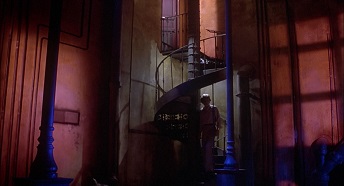
A poet, Rose, finds a rare book in her oddball abode in New York City, a skyline rendered almost like The Cabinet of Dr. Caligari. Her reading material is The Three Mothers, and was procured (conveniently) right next door at an antiques emporium, whose creepy, crippled proprietor looks like Dean Stockwell in Blue Velvet. The tome was penned by a mysterious architect who’s dabbled in alchemy, and whose day job involved building scary structures in three countries, including Rose’s dwelling (also, it should be said, in Germany, home to a certain ballet school of some renown in horror circles).
Rose follows a mysterious trail that leads her onto the city streets and into a cave-like apartment dwelling, part of which is submerged. When her broach/keys fall into an open hole, she descends into the watery depths, a lush visual tapestry courtesy of mentor Mario Bava, who did the Second Unit work when mentee Dario fell ill.
It’s a transcendent space/place, ethereal and not quite liquid, not quite air. It’s a fascinating other-world that Inferno creates and is as as richly pink and blue as a film can get, with only The Abyss, Planet of the Vampires and yes, Blue Velvet able to bi-chromatically compete.
 This is lovely, scintillating stuff — that is, until Rose seeks epistolary input from her brother Mark in Italy. And it’s on Mark’s milquetoast shoulders that the mystery of The Three Mothers rests, and mamma mia is he underwhelming.
The mustachioed university student becomes involved in the evil step mother curse via Verdi, seeing a witch in the middle of classical music appreciation class. It’s a potentially interesting scene, music students all in their own headspace via headphones and the strains of Va, Pensiero from the opera, Nabucco. But it feels solecistic. After all, Mark’s only involved through cross-Atlantic correspondence, while Rose feels things weird things first-hand. It’s a real side-ways step that put a lot of viewers off.
Argento promises us a Rose garden, but ultimately she becomes an entirely fringe character in the weeds, taken over not only by Mark, but also by his classmate Sara and a shoe-horned in countess, Elise (played by then Argento love interest, Daria Nicolodi, mother of Asia).
The evil book curse manifestations make little sense, and seem like an excuse for the director to stuff a supernatural tale with giallo elements he’d become comfortable with (black glove).
Ultimately victims fall to plague-like curses, as Mark wanders from one phantasmagorical dreamworld to another piecing things together.
Best taken in small doses.
*** (out of 5)
[CHECK OUT OUR INFERNO PODCAST!]


 Really Awful Movies